Quick Navigation
Two 3BHK homes in the same Gurgaon society, with similar carpet area and similar layout, can end up with renovation bills that differ by ten or fifteen lakh rupees. The size is the same. What changes is everything underneath the surface: the materials, the finishes, the level of customisation, the craftsmanship, the services running behind the walls, and how much detailing goes into each room.
This is the question most renovation articles skip. They tell you a number, not what that number buys. This guide looks at budget vs. luxury home renovation in Gurgaon from the other direction: what actually changes as you move up the budget, where the money goes, and whether spending more creates value you will notice five years in.
A note before we go further: every cost figure in this article is an indicative estimate based on prevailing Gurgaon renovation trends, not a fixed price list. Actual costs depend on your property’s size, condition, scope and material choices, and can only be confirmed after a proper site assessment and detailed quotation.
Budget vs Luxury Home Renovation: What Actually Changes?
The core difference between budget and luxury home renovation is not the presence of features, but the quality, customisation, and durability behind each one. A budget kitchen and a luxury kitchen may both have a modular layout and soft-close drawers. What differs is the carcass material, the finish, the hardware brand, and how precisely it is fitted to the space.
| Element | Budget | Mid-range | Luxury |
| Materials | Laminate, plywood | Better laminate, veneer accents | Veneer, natural wood, imported stone |
| Flooring | Vitrified tiles | Larger-format tiles, engineered wood | Italian marble, solid wood, natural stone |
| Walls and ceilings | Paint, basic false ceiling | Textured paint, layered false ceiling | Designer wall panels, articulated ceiling design |
| Kitchen | Standard modular, laminate shutters | Soft-close fittings, quartz counter | Custom carpentry, PU finish, stone or imported counters |
| Wardrobes | Laminate finish, standard hardware | Better hardware, internal accessories | Veneer or PU finish, full internal customisation |
| Bathroom | Standard sanitaryware, ceramic tiles | Better fittings, glass partition | Designer sanitaryware, natural stone, rain showers |
| Lighting | Basic ceiling fixtures | Layered ambient and task lighting | Designed lighting scheme with accent and mood lighting |
| Electrical/plumbing | Standard wiring, basic fittings | Upgraded points, better switches | Concealed wiring redone, premium fittings, provision for automation |
| Furniture | Ready-made or basic custom | Semi-custom pieces | Fully bespoke, designer-specified furniture |
| Hardware | Standard hinges and channels | Branded soft-close hardware | Premium European hardware |
| Customisation | Minimal | Moderate, on select pieces | Extensive, across most spaces |
| Smart-home features | Rare | Occasional, on request | Integrated lighting, climate and security automation |
| Craftsmanship | Standard site execution | Skilled carpentry on key pieces | Specialised artisans for detailing and finishing |
| Project management | Basic supervision | Regular site visits | Dedicated supervision with vendor coordination |
The table shows a pattern worth noticing: the further up the tier, the more the money goes into things you touch, use, and see daily, rather than things you can photograph once and forget.
Home Renovation Cost Tiers in Gurgaon
Home renovation cost in Gurgaon typically falls into three broad tiers: budget renovation at roughly ₹800 to ₹1,500 per square foot, mid-range at ₹1,500 to ₹3,000 per square foot, and luxury renovation at ₹3,000 to ₹7,000 or more per square foot. These are indicative planning ranges seen across the Gurgaon and Delhi NCR market, not confirmed pricing.
| Tier | Indicative cost (per sq. ft.) | Typical 2–3BHK total (indicative) |
| Budget | ₹800 – ₹1,500 | ₹8 lakh – ₹15 lakh |
| Mid-range | ₹1,500 – ₹3,000 | ₹15 lakh – ₹28 lakh |
| Luxury/premium | ₹3,000 – ₹7,000+ | ₹30 lakh – ₹50 lakh+ |
Actual pricing for any specific home will vary based on:
- Property size and layout, since larger homes have more surface area but can also benefit from economies of scale on procurement
- Existing condition, since older Gurgaon homes often need civil, plumbing, or electrical rework before any finishing work begins
- Scope of work, since a cosmetic refresh costs very differently from a full civil-to-finish renovation
- Material specification, which is the single largest swing factor between tiers
- Level of customisation, since bespoke furniture and detailing take more design and execution time than modular systems
These ranges are useful for early budgeting conversations. A confirmed number for your home would come from Studio Interplay’s own site assessment and a detailed, itemised quotation, which is a separate step from the general estimates given here.
Budget Home Renovation vs. Luxury Renovation: Room by Room
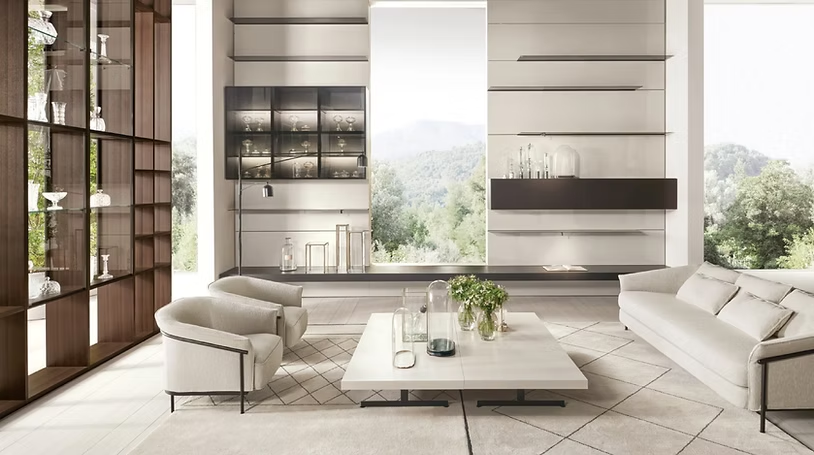
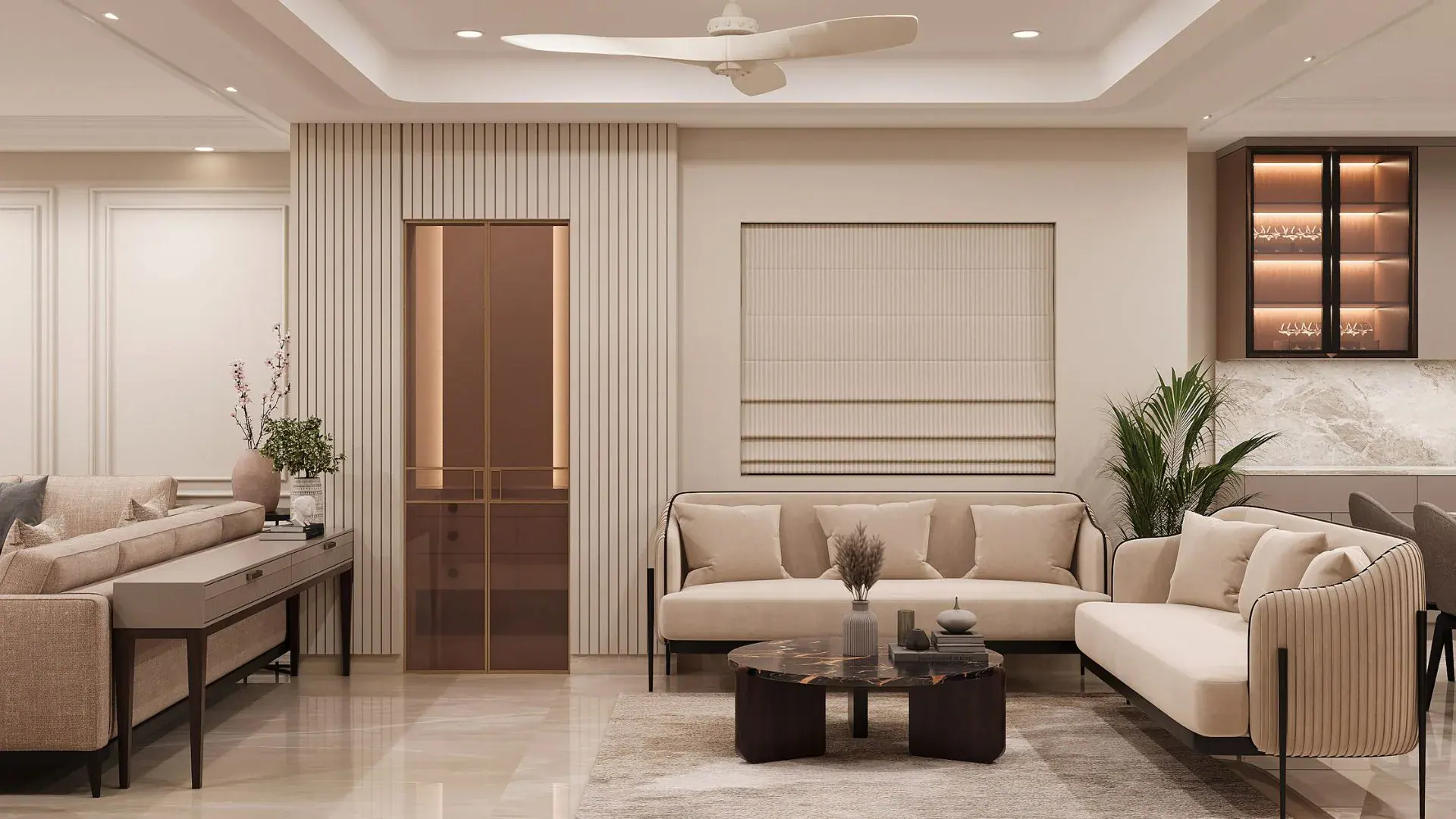
Living room. Budget living rooms typically have painted walls, a simple false ceiling, and ready-made or semi-custom furniture. Luxury living rooms usually have a designed ceiling with layered lighting, feature walls in stone or wood panelling, and fully custom furniture sized to the room’s proportions.
Kitchen. Budget kitchens use laminate shutters, standard hardware, and a basic granite or quartz counter. Luxury kitchens move to PU or veneer finishes, soft-close European hardware, natural stone or imported counters, and sometimes an additional working kitchen for daily cooking.
Bedrooms. Budget wardrobes are laminate-finished with standard internal shelving. Luxury wardrobes get full internal customisation, such as pull-out trays and integrated lighting, and the room often includes a designed headboard wall that a budget scope would skip.
Bathrooms. Budget bathrooms use ceramic tiles and standard sanitary ware. Luxury bathrooms typically involve natural stone or large-format tiles, designer sanitary ware and glass enclosures, sometimes with underfloor heating or rain showers, which change the plumbing scope and timeline.
Dining area. A budget dining space is often just a table and chairs within an open layout. A luxury dining area is treated as its own zone, with dedicated lighting, a feature ceiling element, and sometimes a built-in crockery unit.
Entryway. Budget entryways rarely get separate design attention. Luxury renovations often treat the entry as a first impression, with a designed console, accent lighting, and a distinct flooring transition.
Balcony and utility areas. Budget scopes usually leave these functional and untouched beyond basic flooring or waterproofing. Luxury renovations increasingly extend design here too, particularly balconies converted into usable sitting spaces.
Where Does the Extra Money Go?
This is the question most homeowners actually want answered: If I pay more, what am I paying for?
- Material quality: the difference between laminate and veneer, or ceramic tile and natural stone, accounts for a large share of the cost gap
- Custom furniture: bespoke pieces designed for a specific space cost more in design and carpentry time than semi-custom or ready-made options
- Hardware: European soft-close hinges and channels cost several times more than standard hardware, and it adds up across an entire home
- Natural vs engineered materials: natural wood, marble, and stone cost more to source, transport, and install than engineered equivalents
- Bespoke detailing: custom mouldings, articulated ceilings and wall panelling need more design hours and more skilled execution than standard finishes
- Lighting: a layered scheme with multiple circuits and fixture types costs more in design and electrical work than one ceiling light per room
- MEP upgrades: rewiring, replumbing or upgrading electrical load, especially in older Gurgaon apartments, is easy to underestimate
- Structural changes: breaking or reconfiguring walls adds civil work, debris removal, and often structural consultation
- Imported or premium finishes: imported tiles, stone, and fittings carry import duty and logistics costs on top of the material price
- Craftsmanship: specialised carpenters and finishing artisans charge more than general labour, and their time is a meaningful part of the luxury-tier premium
- Site supervision: closer, more frequent supervision reduces execution errors, which is part of why luxury projects include more dedicated project management
None of these are cosmetic add-ons. Each one changes something structural about how the finished space performs and how long it lasts.
What Should You Spend More On
Not every upgrade delivers equal value. A useful way to decide is to ask how often a surface or fixture is touched or used daily.
Worth spending more on:
- Kitchen counters and cabinetry, given daily use and exposure to heat, water and stains
- Bathroom fittings and waterproofing, since repairs later are disruptive and expensive
- Wardrobe hardware, since cheap channels and hinges fail faster under daily use
- Lighting design, since it affects how the entire home feels every single day
- Flooring in high-traffic zones such as the living room and entry
Where a budget option can perform just as well:
- Furniture in rarely used guest rooms
- Decorative wall treatments in low-visibility areas
- Fixtures in utility or storage spaces
- Some soft furnishings, which are relatively easy and inexpensive to upgrade later
Durability, maintenance and resale value should guide the decision more than visual appeal alone. A well-chosen mid-range material that lasts a decade often delivers better value than a premium finish that needs early replacement due to poor installation or mismatched use.
Can a Budget Renovation Still Look Expensive?
Yes. A well-planned budget renovation can look considerably more premium than its cost suggests, mainly through space planning, lighting, and disciplined material selection rather than higher spending.
The factors that make the biggest visual difference are often not the most expensive ones:
- Space planning: a well-proportioned layout looks more considered than a cramped one, regardless of material cost
- Lighting: even basic fixtures, placed and layered thoughtfully, change the perceived quality of a room significantly
- Colour coordination: a consistent, well-chosen palette reads as more expensive than a mismatched one with pricier materials
- Proportions: furniture and fixtures sized correctly for the room feel intentional, while oversized or undersized pieces feel like an afterthought
- Selective customisation: putting the renovation budget into one or two focal pieces, such as a feature wall or a well-detailed kitchen, creates more visual impact than spreading a small budget thin across every room
- Disciplined material selection: choosing fewer, well-matched materials consistently often looks more polished than mixing many different finishes to save cost in patches
This is where design judgement matters more than budget size. A ₹10 lakh renovation with strong planning can outperform a ₹15 lakh renovation with weak planning.
When Is Luxury Renovation Actually Worth It?
Luxury-tier renovation tends to justify its cost in specific situations rather than as a default choice.
- Long-term ownership: if you plan to live in the home for years, higher-quality materials and craftsmanship amortise their cost over a longer period
- High-use spaces: kitchens, main bathrooms and living areas see enough daily wear that better materials genuinely reduce maintenance issues
- Bespoke requirements: unusual layouts or storage needs that standard modular systems cannot accommodate well
- Larger homes: bigger floor plates often need more deliberate space planning and detailing to avoid feeling empty or disjointed
- Architectural detailing: homes with distinctive ceiling heights or unusual layouts benefit from design attention a standard renovation would skip
- Homeowners prioritising materials and craftsmanship: some simply value natural materials and fine detailing as part of how they live, independent of resale considerations
Luxury renovation is not inherently better than a budget or mid-range approach. It is a better fit for specific priorities, and the decision should follow those priorities rather than a general assumption that more spend equals more value.
How to Set a Realistic Home Renovation Budget in Gurgaon
A practical framework for approaching your budget:
- Define the scope clearly: cosmetic refresh, partial renovation, or full civil-to-finish overhaul
- Assess the existing condition: older Gurgaon apartments often need hidden civil, plumbing or electrical work before finishing can begin
- Account for design fees: separate from material and execution cost, usually a small percentage of the total project value
- Budget for materials realistically: this is where budget, mid-range and luxury choices create the biggest cost divergence
- Include labour and execution costs: skilled carpentry and finishing work form a significant share of the total, particularly at higher tiers
- Factor in appliances and furniture where applicable: these are sometimes treated as separate from the core budget and easy to underestimate
- Keep a contingency: most experienced homeowners and designers in Gurgaon suggest keeping 10 to 15 percent aside for unforeseen site issues
- Watch for hidden or overlooked costs: GST, statutory society approvals, temporary storage and site access logistics in high-rises all add up if not planned for
A realistic budget accounts for what you can see in a quotation and what typically surfaces once work begins, particularly in older properties.
Planning Your Renovation with Studio Interplay
Budget, mid-range and luxury renovations are not fixed labels as much as they are different combinations of materials, customisation and craftsmanship, each suited to different homes and priorities. The right tier for your home depends on how long you plan to live there, which spaces matter most to your daily routine, and how much customisation you actually need.
Studio Interplay works with Gurgaon homeowners across this full range, from disciplined budget-conscious renovations to fully bespoke luxury projects, with an approach grounded in space planning, detailed drawings and transparent, itemised quotations rather than vague estimates. If you are considering house renovation services in Gurgaon and want to understand what your specific home and budget can realistically achieve, it is worth discussing your property, scope and priorities directly with the team before finalising any numbers.
Frequently Asked Questions
- What is the biggest cost difference between budget and luxury renovation?
The biggest difference is material quality and customisation level. Budget renovations use laminate, standard hardware and modular systems, while luxury renovations use natural materials, premium hardware and bespoke furniture designed for the specific space.
2 .Is luxury renovation worth the extra cost?
It depends on how long you plan to live in the home and how much you use high-wear spaces like the kitchen and bathrooms. For long-term ownership and daily-use areas, luxury materials often justify the added cost through durability and reduced maintenance.
- Can I renovate only selected rooms at a luxury level?
Yes. Many homeowners choose a hybrid approach, applying luxury-tier detailing to the kitchen or living room while keeping bedrooms or utility areas at a mid-range or budget specification. This is a common and practical way to manage overall cost.
- What percentage of a renovation budget should go toward finishes?
Finishes and materials typically account for a significant share of the total renovation cost, often more than labour alone, though the exact percentage varies by scope. A detailed BOQ from your designer will show this breakdown for your specific project.
- How much contingency should I keep?
Most Gurgaon renovation projects benefit from a contingency of 10 to 15 percent of the total budget, particularly in older properties where civil or plumbing issues are more likely to surface once work begins.
- Does renovation cost more in older Gurgaon homes?
Often, yes. Older homes frequently need hidden civil, electrical or plumbing rework before finishing work can start, which adds cost that newer properties typically avoid.
- Can premium materials reduce maintenance costs?
In many cases, yes. Materials like natural stone, better hardware and quality waterproofing can reduce the frequency of repairs and replacements over time, though the upfront cost is higher.
- How can I reduce renovation costs without compromising quality?
Focus higher spending on high-use areas like the kitchen and bathrooms, use mid-range materials consistently rather than mixing many finishes, and finalise the design and BOQ before execution begins to avoid costly mid-project changes.
- What should I prioritise if my budget is limited?
Prioritise space planning, lighting and the kitchen and bathrooms, since these affect daily living the most. Furniture in low-use rooms and decorative elements in low-visibility areas can be upgraded later.
- How do I get a renovation estimate in Gurgaon?
An accurate estimate requires a site visit to assess the existing condition, followed by a scope discussion and a detailed, itemised quotation. General per-square-foot ranges are useful for early budgeting but should not be treated as a final price.

Co-Founder & Principal Designer at Studio Interplay
Palak approaches design as a dialogue between space and emotion. With a deep appreciation for materiality and detail, she creates interiors that reflect the people who inhabit them rather than the trends of the moment.