Quick Navigation
A luxury villa is not simply a large house. That distinction sounds obvious, but it’s one that gets lost surprisingly often – in oversized rooms that feel empty, in grand facades that don’t relate to the spaces behind them, in interiors that were designed separately from the architecture and never quite came together.
True luxury villa architecture design is about a completely different quality of thinking. It’s about the relationship between spaces. The way morning light moves through a double-height living room. The sequence from the entrance gate to the front door. The conversation between the pool terrace and the interior living zone. Every one of these moments is a design decision – and in the finest villas, none of them happen by accident.
If you’re planning a luxury villa in India and want to understand what separates genuinely exceptional design from expensive construction, this guide is for you.
The First Principle: Architecture and Interior Design Are One Decision
The most expensive mistake in luxury villa projects is treating architecture and interior design as two separate phases. Architect completes the structure. Interior designer arrives later. Furniture is chosen last.
This sequence produces homes where things don’t quite align – ceiling heights that don’t suit the furniture scale, window positions that create glare on seating arrangements, corridor widths that feel right on plan but awkward in person.
The best luxury villa architecture design starts from a single brief that encompasses both disciplines simultaneously. The room height is determined with full knowledge of how it will be furnished. The window is positioned knowing exactly what view the resident will see from their bed. The kitchen layout is driven by how a family cooks and entertains, not just by plumbing positions.
This integration is not a stylistic preference. It’s a structural requirement for quality.
Luxury Villa Design Ideas That Stand the Test of Time
The Zoned Plan: How Great Villas Manage Privacy and Sociality
One of the defining features of the best villa design in India is how intelligently public and private zones are separated. A luxury villa accommodates both grand entertaining and deep domestic privacy – and the floor plan must serve both without compromise.
The smartest villa architecture plans create a clear hierarchy:
- Public zone: Entry, living, dining, and kitchen – generously proportioned, connected to outdoor entertaining areas
- Semi-private zone: Home office, library, family room – spaces for the household, not for guests
- Private zone: Bedrooms, dressing rooms, personal terraces – completely separated from the circulation of the rest of the home
This zoning isn’t about compartmentalising. It’s about ensuring that the home serves different purposes at different times – a dinner party on Saturday evening, a quiet Sunday morning, a working Wednesday – without any zone intruding on another.
The Facade as the First Statement
Luxury villa exterior design is not decoration applied to a building. It is the architectural idea made visible.
The best contemporary villa facades in India share certain qualities:
- Material honesty: Natural stone, exposed concrete, warm timber screens – materials that carry visual weight and age beautifully rather than painted finishes that date quickly
- Deliberate openings: Windows and voids positioned for view, light, and proportion – not just for elevation symmetry
- Connection to landscape: The facade shouldn’t read as a wall – it should create a relationship between what’s inside and the ground, planting, and sky around it
Jali screens in contemporary materials, deep overhanging rooflines that manage solar gain, and the careful use of water features at the entry sequence – these are the luxury villa architecture ideas that create an arrival experience rather than just a facade.
Indoor-Outdoor Living as a Design System
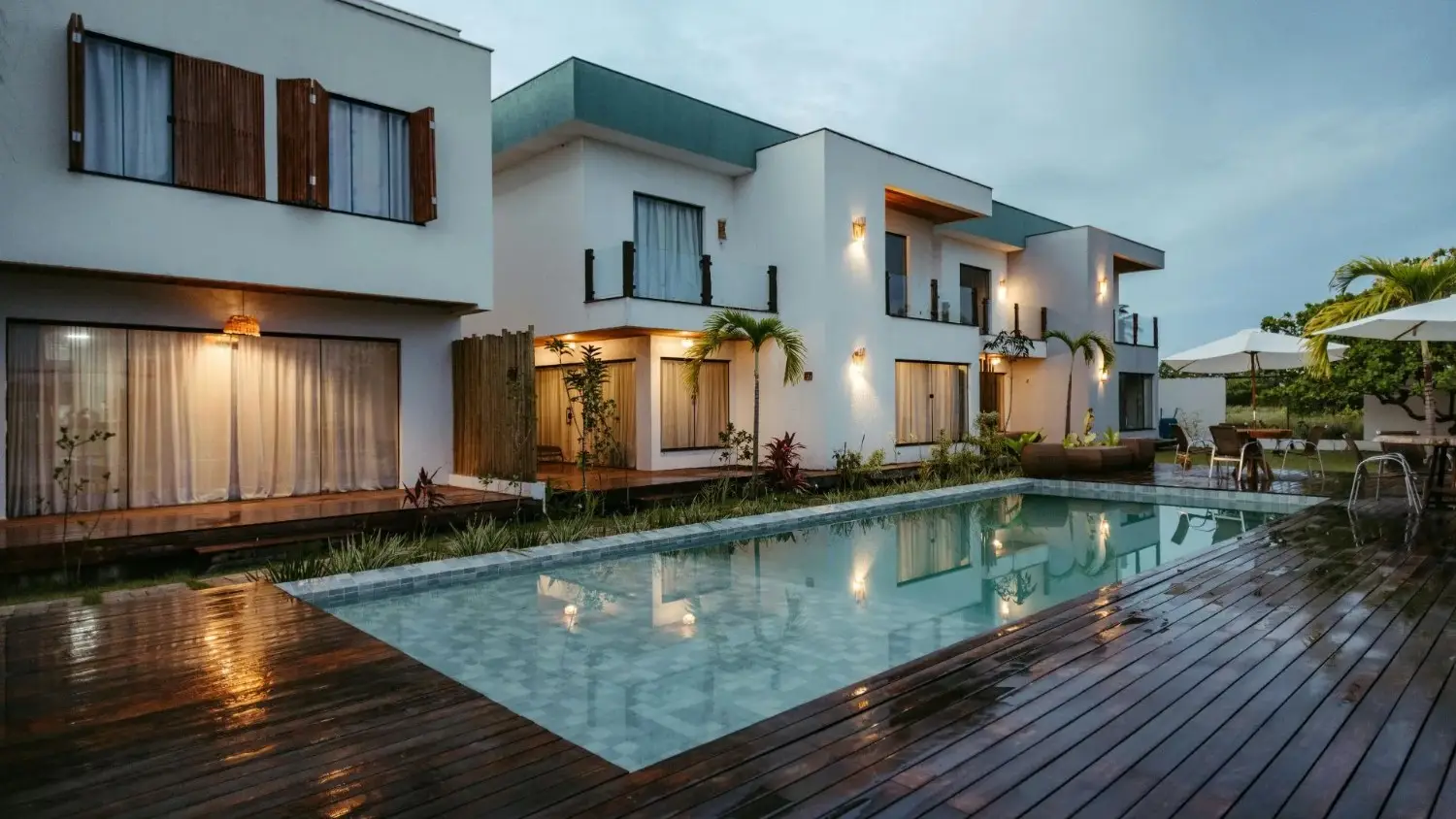
India’s climate, when designed for rather than ignored, makes genuine indoor-outdoor living possible for a significant portion of the year. The finest modern villa architecture designs in India treat this as a spatial opportunity rather than a seasonal bonus.
This means:
- Living rooms that open fully to covered terraces through large sliding or pivot doors
- Pool decks designed as extensions of interior living space – same flooring material, consistent ceiling plane, continuous furniture logic
- Landscaping designed alongside the architecture, not added after – so the planting supports privacy, framing of views, and microclimate management simultaneously
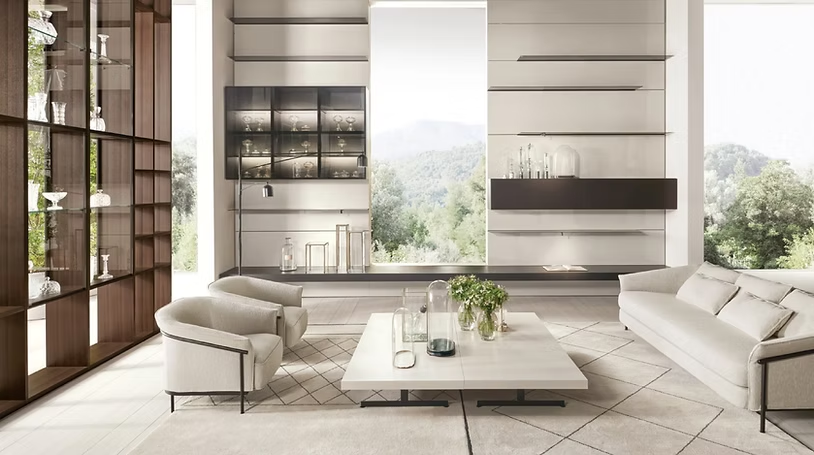
Villa interior design ideas and exterior architecture must speak the same material language for this to work. The stone on the terrace and the stone inside. The timber ceiling that continues from the living room through to the covered outdoor dining. These material continuities are what make a villa feel expansive and connected rather than a building with a garden attached.
The Materials That Define a Luxury Villa
Material specification in interior design for villa projects determines almost everything about how a completed space feels. The weight of a door. The warmth underfoot. The way light reflects off a wall at different times of day.
The materials consistently found in India’s finest luxury villas:
- Natural stone: Marble, limestone, quartzite – each with its own character, used in ways that respond to light rather than simply covering surfaces.
- Solid wood and veneer: In joinery, ceiling elements, and furniture – for warmth and the sense of craftsmanship that no composite can replicate.
- Textured wall finishes: Microcement, Venetian plaster, limewash – finishes that carry depth and age gracefully rather than looking new for two years and deteriorating.
- Aged brass and gunmetal hardware: Details that patina over time and feel considered rather than off-the-shelf.
The specification of these materials, and the combinations they create together, requires both design intelligence and experience – knowing how materials behave over time, how they respond to India’s climate, and how they relate to each other at junctions and transitions.
Why Studio Interplay Designs Luxury Villas Differently
Studio Interplay is a founder-led architecture and interior design studio based in Gurugram, delivering luxury villa architecture design and residential projects across Delhi NCR and India. Founded by principal architect Aditya Puri and principal designer Palak Ranpura, the studio operates on a single governing principle: a villa should be designed as one unified system, not assembled from separate decisions.
Aditya brings structural rigour, spatial intelligence, and climate-responsive thinking to every project – villa architecture plans that work with the site’s orientation, manage India’s seasonal extremes without sacrificing the experience of openness, and create spatial sequences that feel intentional at every step.
Palak brings material depth and interior sensitivity – ensuring that the architectural decisions made at the structural level translate into finished spaces that feel warm, personal, and genuinely luxurious to inhabit daily.
Their architectural planning services span the full project lifecycle: site evaluation, brief development, concept design, 3D visualisation, material specification, working drawings, regulatory coordination, and active site supervision through to handover. Every budget is transparent from the outset. Every timeline is set and held. And the founding principals remain personally involved throughout – not as occasional reviewers, but as the people accountable for the outcome.
Their residential portfolio across Gurugram, Delhi, and Noida reflects a consistent design quality: villas where the facade, the spatial sequence, the interior finish, and the landscape all read as the work of a single, coherent vision.
Your Villa Deserves Architecture That Is As Thoughtful As It Is Beautiful
A luxury villa is a once-in-a-generation investment – in your comfort, your family’s daily experience, and the long-term legacy of a home built to endure. Getting it right requires a team that thinks about architecture and interiors as one continuous act, brings deep material knowledge to every specification decision, and remains personally invested from the first sketch to the final handover.
Studio Interplay builds exactly those villas. If you are ready to begin designing the home that reflects your vision and your life with genuine precision and care, the most important conversation you can have starts here.
Frequently Asked Questions
Q1: What makes luxury villa architecture design different from standard residential architecture?
Luxury villa design demands a deeper brief, greater material intelligence, and genuine integration of architecture and interiors from the very first concept. The difference isn’t only in scale or materials – it’s in the level of considered thought applied to every spatial decision, from how morning light enters the master bedroom to how the gate arrival sequence sets the tone for the entire home.
Q2: How important is zoning in luxury villa design?
Extremely important. A well-zoned villa plan separates public entertaining areas from family spaces from private bedroom suites – allowing the home to serve very different purposes simultaneously without any zone intruding on another. This is one of the most commonly underplanned aspects of luxury villa design.
Q3: What are the best materials for luxury villa exterior design in India?
Natural stone cladding, exposed concrete, timber screens or louvres, and large-format glass are the most enduring choices for Indian villas. They age well, respond beautifully to light, and maintain their quality over years of exposure to India’s climate better than painted render finishes.
Q4: Should architecture and interior design be done by the same studio for a villa project?
For the best outcome, yes. When both disciplines are managed by the same team from the same brief, the result is a level of spatial and material coherence that separately managed projects rarely achieve. The ceiling height, window position, floor material, and furniture scale are all decisions that should be made in full awareness of each other.
Q5: What does a full luxury villa architecture project scope include?
A comprehensive scope covers site analysis, spatial planning, exterior and facade design, interior design, material specification, landscape coordination, working drawings, regulatory approvals, and active site supervision through construction. Studio Interplay delivers this complete scope under one team, with both principals personally involved throughout.
Q6: How long does a luxury villa architecture project take from brief to handover?
A full luxury villa project typically takes 18 to 30 months from initial brief to construction handover, depending on plot size, scope complexity, and regulatory context. Studio Interplay establishes a detailed, realistic timeline at the outset and maintains clear communication at every project stage.
Q7: Can a luxury villa be designed to respond to India’s climate without sacrificing the open, airy feeling?
Absolutely – and the best villa designs in India are climate-responsive by design. Deep overhangs manage summer solar gain. Courtyard elements create natural ventilation. Careful orientation captures winter sun and summer shade. Climate-responsive design and spatial generosity are not in conflict – they reinforce each other when handled by an experienced architect.
Q8: What is the role of landscape design in a luxury villa project?
Landscape is not an add-on to villa architecture – it is part of the architectural system. Planting provides privacy, frames views, manages the microclimate around the building, and creates the setting for indoor-outdoor living. The finest villas design landscape alongside architecture from the very beginning, not as a separate later project.
Q9: How does Studio Interplay approach villa interior design ideas differently?
Studio Interplay treats villa interiors not as decoration applied to completed architecture, but as part of the same design act. Material selections, ceiling treatments, bespoke joinery, and furniture specification are developed in parallel with the architectural drawings – ensuring complete coherence between what the building does spatially and what it feels like to inhabit.

Co-Founder & Principal Designer at Studio Interplay
Palak approaches design as a dialogue between space and emotion. With a deep appreciation for materiality and detail, she creates interiors that reflect the people who inhabit them rather than the trends of the moment.