Quick Navigation
A wardrobe is one of the few pieces of furniture you touch every single day, twice a day, for as long as you live in the home. Yet it is often the last thing homeowners research properly, chosen in a rush after the kitchen, the flooring, and the living room have already used up most of the attention and budget.
This is a mistake that shows up later, not immediately. A wardrobe with the wrong material warps in humidity. Cheap channels stop sliding smoothly within a year. A layout that looked fine on paper turns out to have no space for folded clothes. Choosing the right modular wardrobe designer in Gurgaon is less about picking a nice finish from a catalogue and more about asking the right questions before you sign anything. This guide is a checklist.
Note on cost figures: every price mentioned in this article is an indicative market range based on prevailing Gurgaon trends, not a fixed quotation. Actual cost depends on your wardrobe size, material choice, mechanism, and finish, and should be confirmed through a proper site measurement and quotation.
What Does a Modular Wardrobe Designer Actually Do?
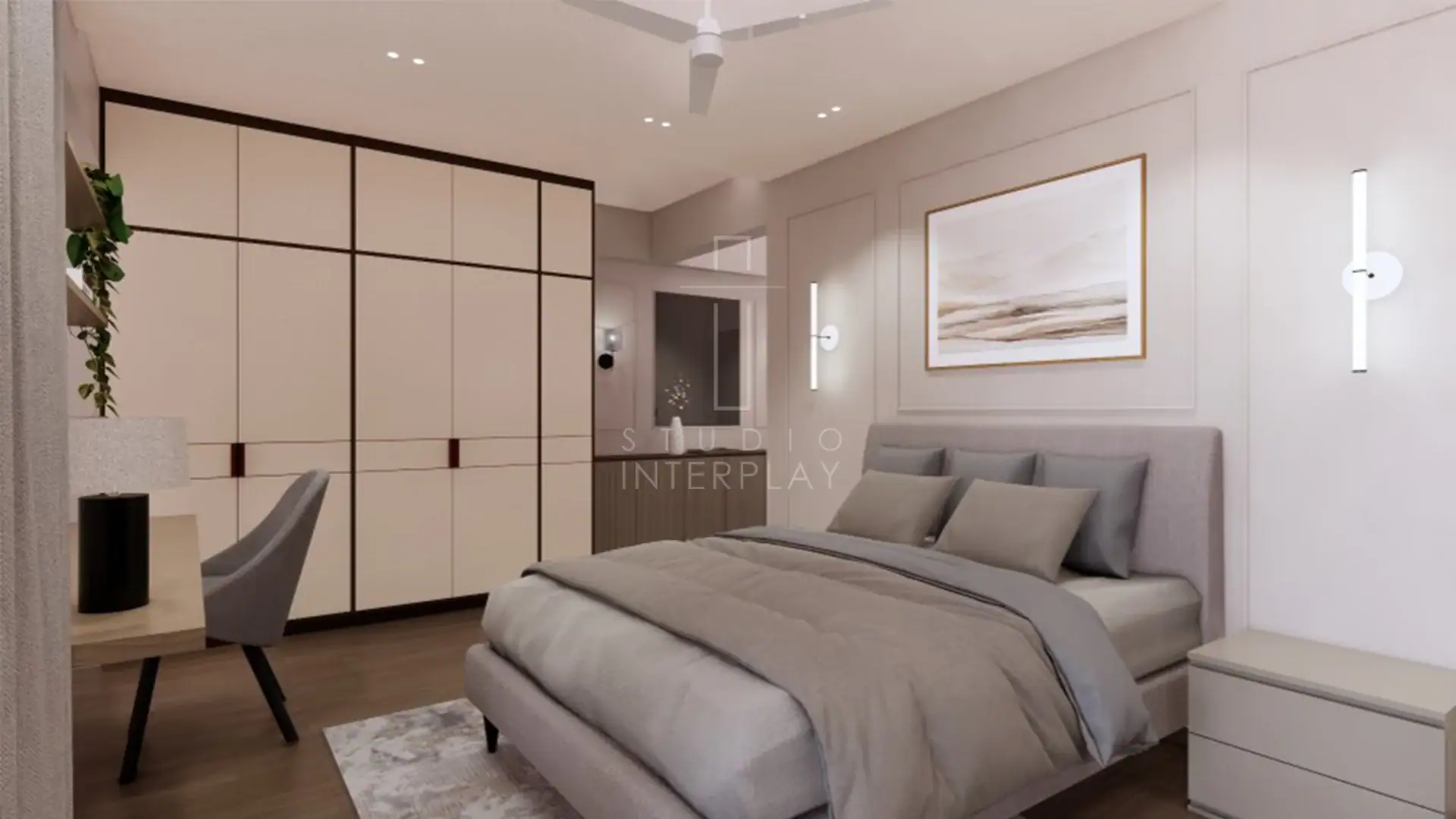
A modular wardrobe designer plans the layout, internal storage configuration, material specification, finish and door mechanism of the wardrobe based on the room’s dimensions and the homeowner’s actual clothing and storage habits. This is different from simply picking a wardrobe from a catalogue. A designer works out how much hanging space you need versus shelving, where drawers should sit for daily accessibility, how the wardrobe should handle the room’s humidity and light, and how it visually fits with the rest of the bedroom.
The design step matters because a wardrobe is a fixed, built-in piece. Unlike furniture you can replace easily, correcting a poorly planned wardrobe after installation usually means tearing it out and starting again.
Modular Wardrobe vs Carpenter-Made Wardrobe: What Actually Changes?
| Factor | Modular Wardrobe | Carpenter-Made Wardrobe |
| Manufacturing | Factory-made panels, precision machinery | Built on-site by hand |
| Finish quality | Consistent factory finish, clean edge-banding | Depends heavily on individual carpenter’s skill |
| Material options | Wide range of boards, laminates and finishes available | Often limited to what the carpenter regularly sources |
| Installation time | Faster, since components are pre-manufactured | Slower, since everything is built at the site |
| Site mess | Minimal, mostly assembly | Higher, due to on-site cutting and finishing |
| Customisation | High, within a structured design and material system | High, but dependent on the carpenter’s design ability |
| Consistency across units | Reliable across multiple wardrobes in the same home | Can vary between units even in the same project |
| Long-term durability | Predictable, tied to the material grade chosen | Variable, tied to workmanship and material sourcing |
| Warranty | Usually offered by the firm or manufacturer | Rarely formalised in writing |
Neither option is automatically better in every situation. A skilled local carpenter can still produce excellent work, particularly for a single simple wardrobe. A modular approach tends to win on consistency, finish quality and accountability, especially across a full home with multiple wardrobes that need to look and perform the same way.
Sliding vs Hinged vs Walk-In Wardrobe: Which Type Suits Your Room?
Sliding wardrobes work best in space-constrained rooms since they need no door-swing clearance, hinged wardrobes suit rooms with adequate open space and offer full visibility of contents, and walk-in wardrobes work best in larger bedrooms or dedicated dressing areas where storage can be zoned separately from the sleeping space.
| Type | Best suited for | Key trade-off |
| Sliding | Compact bedrooms, rooms with furniture close to the wardrobe wall | Slightly higher cost due to tracks and rollers, only one section accessible at a time |
| Hinged | Rooms with enough clearance for doors to swing open | Full visibility and access, but needs floor space in front |
| Walk-in | Larger bedrooms, dedicated dressing rooms | Highest space requirement, but the most organised and flexible storage |
For a typical Gurgaon apartment bedroom, sliding wardrobes are frequently the practical choice simply because bedroom sizes in many 2BHK and 3BHK layouts do not comfortably accommodate hinged door clearance. Hinged wardrobes tend to suit larger or independent floor homes where space is less constrained. Walk-in wardrobes are the least common choice, mainly because they require a room size most Gurgaon apartments do not have, but they offer the best organisation when space allows.
Modular Wardrobe Material Guide: What Actually Goes Into a Wardrobe
The material used for the wardrobe carcass, meaning the internal structure, matters more for long-term performance than the visible finish. This is especially important in Gurgaon, where humidity during monsoon months can affect poorly chosen materials over time.
- Plywood: generally the most durable and moisture-resistant option, particularly marine or BWP grade plywood, though it comes at a higher cost
- MDF (medium-density fibreboard): smooth and good for detailed finishes, but more prone to swelling if exposed to consistent moisture
- Particle board: the most economical option, suitable for drier areas of the home, but the least moisture-resistant of the common choices
- HDHMR (high-density HMR board): a denser, more moisture-resistant alternative to standard MDF, often used as a mid-range option
Moisture-resistant materials for wardrobes matter most in areas prone to humidity, near bathrooms, or in ground-floor and basement rooms. If your bedroom is close to a bathroom wall, faces a humid orientation, or is on a lower floor with limited ventilation, asking specifically about BWP plywood or HDHMR grade boards for the carcass is worth the extra conversation with your designer.
Modular Wardrobe Finish Options Explained
The finish is the visible surface layer on the shutters, and it affects both appearance and day-to-day durability.
- Laminate: the most common and economical finish, available in a wide range of colours and textures, reasonably durable for daily use
- Membrane: a slightly more premium wrap finish, often used for a matte, seamless look, moderately priced
- Acrylic: a high-gloss finish with a modern look, more prone to showing scratches and fingerprints than laminate
- PU (polyurethane) paint: a smooth, premium finish with good scratch and moisture resistance, but a higher cost and longer production time
- Veneer: a natural wood finish, offering a premium look, but requires more careful maintenance than synthetic finishes
- Glass (mirror or fluted): used mainly on sliding shutters, adds a distinct look but is the most cost-sensitive to installation quality and handling
There is no universally best finish. The right choice depends on how much daily wear the wardrobe will see, how much maintenance you are willing to do, and how the finish fits with the rest of the room’s material palette.
Modular Wardrobe Cost in Gurgaon: What Affects the Price
Modular wardrobe costs in Gurgaon typically range from roughly ₹900 to ₹3,500 per square foot, depending on the door mechanism, carcass material, and finish selected. These are indicative ranges seen across the Gurgaon market, not a fixed price for any specific wardrobe.
| Tier | Indicative cost (per sq. ft.) | What it typically includes |
| Basic | ₹900 – ₹1,200 | Particle board or basic MDF carcass, laminate finish, standard hardware |
| Mid-range | ₹1,200 – ₹2,000 | HDHMR or better-grade board, membrane or better laminate, branded hardware |
| Premium | ₹2,000 – ₹3,500+ | BWP plywood or veneer, PU or acrylic finish, soft-close premium hardware |
A few factors that move the price within these ranges:
- Door mechanism: sliding wardrobes generally cost more than hinged wardrobes due to track and roller hardware
- Internal accessories: pull-out trays, drawer banks, dedicated shoe racks, and lighting all add to the base cost
- Carcass material grade: moisture-resistant boards cost more than standard particle board but reduce long-term maintenance risk
- Finish choice: PU, veneer, and glass finishes sit at a higher price point than laminate or membrane
- Loft and floor-to-ceiling extensions: additional height adds proportionally to the total cost
Comparing two wardrobe quotes fairly requires matching the width, height, depth, panel count, and accessory list. A lower quote with a smaller carcass board thickness or a basic hardware brand is not automatically better value, even if the visible number looks smaller.
Modular Wardrobe Warranty: What to Actually Check
A warranty is only useful if you know what it actually covers. Before signing, check the following:
- What is covered: hardware, shutters, and carcass material may carry different warranty periods, and this should be stated separately, not as one blanket term
- Duration: typical warranty periods range from one to ten years depending on the component, with hardware often carrying longer coverage than laminate finishes
- What voids the warranty: excessive load, water exposure beyond normal use, or unauthorised repairs can void coverage, and these conditions should be clearly stated
- Who honours it: confirm whether the warranty is backed by the designer, the manufacturer, or a specific hardware brand, since this affects who you contact if something fails
- Service response: ask how service requests are handled and what the typical turnaround time is for repairs under warranty
A firm that provides warranty terms in writing before installation is generally more reliable than one that only mentions warranty verbally during the sales conversation.
The Buyer’s Checklist: Things to Check Before Hiring a Modular Wardrobe Designer in Gurgaon
Use this as a practical checklist before you commit to a designer or firm:
- Portfolio relevant to wardrobes specifically, not only kitchens or general interiors
- A proper site visit and measurement before any quotation is finalised
- Detailed layout drawings showing internal configuration, not just an external elevation
- Clear material specification for the carcass, naming the board type and grade, not vague terms like “quality wood”
- Finish options explained with trade-offs, not just samples shown without guidance
- An itemised quotation separating carcass, shutters, hardware, accessories and installation
- Confirmed door mechanism suitability for your room’s dimensions and clearance
- Warranty terms in writing, specifying duration and what is covered for each component
- A realistic installation timeline, typically a few weeks from design approval to fitting
- After-installation service commitment, including how repair requests are handled
If a designer or firm cannot answer most of these clearly and in writing, it is worth treating that as a signal to look further before committing.
Common Mistakes to Avoid When Hiring a Wardrobe Designer
- Choosing based on the shutter finish alone: the carcass material affects durability far more than the visible finish
- Skipping the site measurement step: an accurate wardrobe design depends on precise room dimensions, not estimated ones
- Not asking about moisture resistance: this matters more than most homeowners realise, particularly in humid or poorly ventilated rooms
- Comparing quotes without matching specifications: a cheaper quote with a lower board grade is not the same product as a more expensive one with better materials
- Ignoring internal layout planning: a wardrobe with beautiful shutters but poorly planned internal storage will frustrate daily use
- Not confirming warranty details before installation: verbal assurances are difficult to enforce later if something goes wrong.
Planning Your Wardrobe with Studio Interplay
A wardrobe is used daily, seen daily, and difficult to correct once installed, which makes the choice of designer more important than it might first seem. The right modular wardrobe design in Gurgaon comes down to a few consistent factors: a designer who measures properly, specifies materials clearly, explains trade-offs honestly, and puts warranty terms in writing before work begins.
Studio Interplay works with Gurgaon homeowners on wardrobe design as part of a considered, room-by-room approach, focusing on layout, material suitability, and finish selection based on how the space is actually used. If you are evaluating a modular wardrobe designer in Gurgaon and want a clear, itemised understanding of what your specific room and budget can achieve, it is worth discussing your requirements with the team before finalising any design.
Frequently Asked Questions
- How do I choose a good modular wardrobe designer in Gurgaon?
Check their portfolio for wardrobe-specific work, confirm they conduct a proper site measurement, ask for detailed layout drawings and an itemised quotation, and get warranty terms in writing before signing.
- What is the difference between a modular wardrobe and a carpenter-made wardrobe?
Modular wardrobes use factory-manufactured panels with consistent finishing and faster installation, while carpenter-made wardrobes are built on-site and depend heavily on individual craftsmanship and material sourcing.
- Should I choose a sliding, hinged, or walk-in wardrobe?
Sliding wardrobes suit compact rooms since they need no door-swing clearance, hinged wardrobes suit rooms with enough open space, and walk-in wardrobes work best in larger bedrooms with a dedicated storage zone.
- What is the best material for a moisture-resistant wardrobe?
Marine or BWP-grade plywood and HDHMR boards offer the best moisture resistance among common wardrobe carcass materials, which matters most in humid rooms, bathroom-adjacent walls, or ground-floor spaces.
- What is the average modular wardrobe cost in Gurgaon?
Modular wardrobe costs in Gurgaon typically range from around ₹900 to ₹3,500 per square foot, depending on the mechanism, material, and finish chosen. These are indicative figures, and the actual cost depends on your specific requirements.
- Is a sliding wardrobe more expensive than a hinged wardrobe?
Generally, yes. Sliding wardrobes usually cost more than hinged wardrobes of a similar size due to the additional track and roller hardware required for the sliding mechanism.
- What finish is best for a modular wardrobe?
There is no universally best finish. Laminate offers durability at a lower cost, PU and veneer offer a premium look with higher maintenance needs, and the right choice depends on daily use and budget.
- What warranty should I expect on a modular wardrobe?
Warranty periods vary by component, with hardware often covered for longer than shutters or laminate finishes. Always ask for warranty terms in writing, specifying what is covered and what voids the coverage.
- Can I customise the internal layout of a modular wardrobe?
Yes, this is one of the main advantages of working with a dedicated designer. Internal configuration, including shelving, drawers, and hanging space, can be planned around your specific storage needs rather than a fixed template.
- How long does it take to install a modular wardrobe in Gurgaon?
Most modular wardrobe projects take a few weeks from design finalisation to installation, since panels are manufactured off-site and assembled on installation day, which significantly reduces on-site time compared to carpenter-made options.
- What should I check before finalising a wardrobe quotation?
Confirm the quotation lists carcass material, shutter finish, hardware brand, accessories, and installation separately, rather than as a single lump-sum figure, so you can compare it fairly against other quotes.

Co-Founder & Principal Designer at Studio Interplay
Palak approaches design as a dialogue between space and emotion. With a deep appreciation for materiality and detail, she creates interiors that reflect the people who inhabit them rather than the trends of the moment.